Best Handwriting Picture Book Series

Four Pirate Adventures. Four Visual Handwriting Discoveries.

Discover a different way to learn lowercase letter formation.

Join the pirates as they explore their island and uncover the shapes hidden within lowercase letters.

From seaweed and coconuts to turtle tracks and shark teeth, each adventure uses imaginative visual clues to help children recognise letter patterns, understand starting points and become familiar with the movements used to form letters.

Kids can learn letter formation visually from a storybook

These story-based picture books help children learn how to form lowercase letters the right way—through engaging characters and visual storytelling, not repetitive worksheets. Young learners can visually see the similarities in the letters. Each book guides young learners step-by-step, showing how letters are shaped and why, so children naturally understand proper formation as part of the story.

Designed for preschool and early primary years, this series builds strong handwriting foundations while keeping learning enjoyable and meaningful. It’s a gentle, effective way to support early writing skills—perfect for parents, teachers, and anyone looking to help children develop confident, correct handwriting from the very beginning.

Why Visual Letter Grouping Makes a Difference

Grouping letters by similar shapes helps children build both muscle memory and visual recognition more effectively. When letters are introduced in carefully chosen groups, learners begin to notice patterns in how letters are formed, making it easier to remember and reproduce them correctly. This structured approach supports consistent, confident handwriting from the very beginning.

By practising letters with related shapes, children strengthen fine motor skills through repeated, meaningful movements rather than isolated drills. Over time, this reduces common issues like letter reversals and confusion, as children develop a clear and reliable understanding of how each lowercase letter is formed.

The Four-Book Set is available together in one complete book

On amazon

More Than Handwriting Practice – A Visual Journey of Discovery

The Pirate Handwriting collection brings together four imaginative stories, each introducing a different group of lowercase letters through visual storytelling.

Instead of presenting letters in alphabetical order, the books explore related letter shapes and formation patterns.

Children discover:

  • Letter relationships: Recognising familiar shapes within different lowercase letters.
  • Starting positions: Using visual clues to understand where letter formation begins.
  • Letter size: Noticing the differences between short, tall and drop-down letters.
  • Formation movements: Building familiarity and muscle memory through related letter patterns.
  • Vowel awareness: Following the colourful bird’s discoveries throughout the four adventures.

Two Kinds of Treasure

The pirates begin by searching for treasure, but their adventures lead them to two important discoveries.

First, they uncover the visual patterns that help them understand lowercase letter formation.

Then, with the help of a colourful bird, they discover the vowels and why these special letters are needed for reading and spelling words.

Four books bring these discoveries together in one continuing adventure.

A playful story. A visual discovery. A meaningful approach to learning handwriting.
Display cards, posters, and worksheets support the picture books

Letter g, Mastering Sound and Shape

lowercase letter ‘g’ can be a tricky one to learn, both in terms of its sound and its shape. While these challenges are quite common, understanding the reasons behind them can help students overcome confusion. They can master the letter with ease with these helpful tips. Let’s break down two main difficulties students often face when learning the lowercase ‘g’.

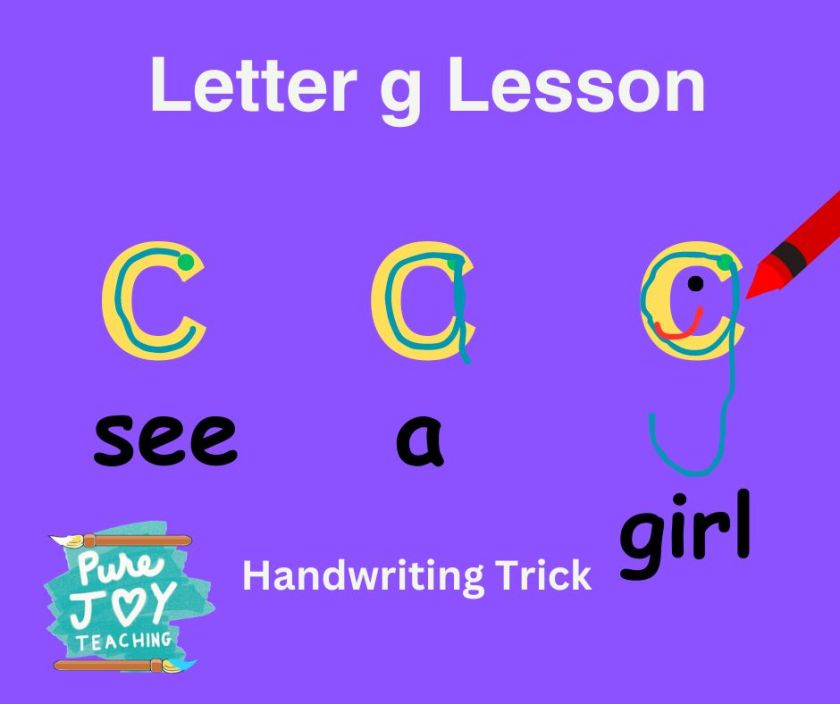
Clever handwriting trick for making the letter and the hard g sound.

Watch this super simple video a few times. Learn to make the lowercase letter g in three easy steps and remember the hard /g/ sound with the word “girl.”

See /c/, /a/, /g/ girl. YouTube Video Here.

Pure Joy Teaching. Handwriting Trick for the Letter /g/.

This video was made at the request of a mother who was trying to teach her daughter to make the lowercase /g/ correctly and remember the letter sound, too.

Understanding the Lowercase Letter ‘g’: Overcoming Common Struggles

For many students, the lowercase letter ‘g’ can be a tricky one to learn, both in terms of its sound and its shape. While these challenges are quite common, understanding the reasons behind them can help students overcome confusion. They can master the letter with ease with these helpful tips. Let’s break down two main difficulties students often face when learning the lowercase ‘g’.

1. Letter Sound Confusion: The Soft ‘g’ and the “j” Sound

One of the biggest challenges students encounter is distinguishing the sound of the letter ‘g.’ When we say the name of the letter “G,” it sounds like the “j” in words like “giraffe.” This can lead to confusion because the letter ‘g’ actually has two distinct sounds in English:

  • The hard ‘g’ sound, as in “go” or “girl.”
  • The soft ‘g’ sound, as in “giant” or “giraffe.”

Because the letter name sounds like a soft “j,” students can mistakenly believe that the letter always makes the soft sound. Helping students practice both the hard and soft sounds of ‘g’ can clear up this confusion.

2. The Shape of Lowercase ‘g’: Confusion with Capital G

Another challenge is the shape of the lowercase ‘g,’ which can easily be confused with the capital letter ‘G.’ The lowercase ‘g’ is unique because it has a loop at the bottom that faces the opposite direction of the capital ‘G.’ This can be difficult for students to grasp, especially since both letters look somewhat similar. If they have learned the capital letter first, they may influenced by that initial shape curving the other direction.

To help students remember the lowercase ‘g’ shape, it’s important to practice writing the letter step by step:

  • Start by drawing the letter /c/.
  • Then, make it into the letter /a/ by sliding up and down to the line.
  • Finally, complete the letter by drawing a little tail that hangs out to the left side. Very simular to the letter /j/ tail.

By focusing on these specific steps and practicing the direction of the curve, students can avoid mixing up the lowercase ‘g’ with its capital counterpart.

The Importance of the Starting Point

The lowercase letters c, a, and g, all have the same starting points. Unlike most lowercase letters the /c/ shaped letters move in the opposite direction of normal English reading. The /c/ shaped letters start at the top and move from right to left. This book is helpful for teaching these letters.

Tips for Teaching the Lowercase ‘g’

  1. Use Visual and Auditory Cues: To reinforce both the sound and shape of ‘g,’ this video can be a helpful tool.
  2. Practice Writing: Give students plenty of opportunities to write lowercase ‘g’ repeatedly, encouraging them to focus on the starting point of the letter /c/. and the direction of the curve. It can also be helpful to trace the letter first, then try writing it independently.
  3. Focus on the Sound: Practice distinguishing between the hard and soft ‘g’ sounds in various words. Reading aloud and singing songs with the letter ‘g’ can help students become more familiar with the sound.

Conclusion

While the lowercase ‘g’ may seem tricky at first, understanding the reasons behind the confusion can help students master both the sound and shape of the letter. By practicing consistently and breaking down the challenges step by step, students can overcome their struggles and gain confidence in their learning journey. With patience and the right approach, the lowercase ‘g’ will become second nature!

Pure Joy Teaching