Letters Links to the Letter Sounds

Unlocking Early Literacy: Why Picture-Embedded Visual Phonics Transforms A-Z Alphabet Learning

Mastering the alphabet is the foundational doorway to reading and writing. Yet for many emergent readers, special education students, and children with learning difficulties, connecting abstract letter shapes to their corresponding speech sounds can present a major cognitive hurdle. Pure Joy Teaching’s lowercase A-Z alphabet resources reimagine foundational literacy instruction by fusing visual sound mnemonics directly into letter shapes and linking motor-stroke handwriting to phonemic awareness.

The Power of Picture-Embedded Letters and Lowercase-First Phonics

Traditional alphabet flashcards typically place an illustration next to a letter—such as an apple drawn beside a standalone letter a. For a struggling learner, the brain must perform two separate visual lookups: processing the letter symbol and then looking over to the illustration to recall the sound.

Pure Joy Teaching’s visual phonics approach embeds mnemonic artwork directly inside the letter shape itself. Because the picture forms the body of the letter, grapheme recognition and phoneme recall occur simultaneously:

  • Direct Symbol-Sound Association: The curve of the letter c forms a curled cat, the long stem of h is a tall hose spraying water out the top, the letter o is an octopus, and the letter s twists like a snake.
  • Lowercase Priority Based on 95% Print Frequency: Research in print frequency demonstrates that approximately 95% of written text in books and classroom materials appears in lowercase. By mastering lowercase letter-sound relationships first, young learners gain immediate access to decoding decodable books and building CVC words.

Double-Sided A-Z Alphabet Cards: Connecting Sounds, Shapes, and Color Cues

The A-Z Visual Phonics Alphabet Card set provides a multi-sensory resource that bridges letter identification, phonemic awareness, and proper stroke formation. Printed nine cards per sheet, these double-sided cards give educators a versatile tool for small-group intervention, flashcard drills, flipbooks, or bulletin board sound walls.

To maximize student engagement and independent self-checking, each card features specific visual cues engineered for early learners:

Card ElementVisual FeaturePedagogical Purpose
Front SidePicture-embedded mnemonic artworkEnables instant visual sound recall
Back SidePlain text letter formConnects mnemonic image to standard print recognition
Green DotsFormation starting dotVisual guide to initiate proper letter formation
Red TrimRed border outlineInstantly highlights short vowel sounds
Black TrimBlack border outlineIdentifies consonant sound cards
Red & Black TrimDual border outlineSignals the tricky dual nature of letter y

Complete A-Z Embedded Mnemonic Anchorage

Every lowercase card incorporates a targeted visual anchor designed around short vowel sounds and core consonant phonemes:

  • Short Vowels: a (apple), e (egg), i (igloo), o (octopus), u (underwear).
  • Consonants: b (balloons), c (cat curled in a c-shape), d (duck with a water line), f (flower), g (goat), h (hose spraying high out of the top), j (jelly spilled in a j-shape), k (kite with a tail), l (ladder), m (mountains and monkeys), n (nest with net covering), p (popcorn), q (queen face with crown and tailing hair), r (raindrops with rainbow), s (snake in an s-shape), t (tigers), v (volcano), w (watermelon), x (exercising boy / box), y (yellow yarn), z (zipper).

Handwriting Letter Strips: Grouping Letters by Shape to Stop Reversals

Handwriting instruction often stumbles when letters are taught strictly in alphabetical sequence. Children frequently mix up mirror-image letters like b and d or p and q because their brains have not yet categorized stroke directions into consistent motor patterns.

The Handwriting Letter Strips solve this by organizing the lowercase alphabet into four logical shape families based on how the pencil moves. Every set includes four strips with picture-embedded mnemonics as well as four clean-font strips (in Comic Sans) with starting dots only, allowing students to transition smoothly from visual prompts to independent writing.

The Four Motor-Stroke Letter Families

  1. Curved C-Shaped Letters (c, a, g, d, q, o, s, e):
    • Formation Logic: All letters in this family begin with the curved hook of the letter c.
    • Reversal Prevention: Children learn that letter c turns into a, and pulling the line further down forms g. Because both c and d hook in the exact same direction, students stop confusing d with b.
  2. Dive-Down R-Shaped Letters (r, n, m, h, b, p):
    • Formation Logic: Students start at the top, dive straight down, and bounce back up over the curve.
    • Consistency: Demonstrating that h and b share the exact same starting dive and rightward loop reinforces proper muscle memory.
  3. Straight-Line Letters (l, i, j, t, f, k):
    • Formation Logic: Simple top-to-bottom vertical strokes build writing confidence and hand control.
  4. Slanted Letters (v, w, x, y, z) & Special Vowel Tracing:
    • Formation Logic: Diagonals and zigzag movements are grouped together for smooth motor transition.
    • Memory Clue for Letter U: Students are reminded that the letter u goes under the underwear, preventing them from flipping it upside down and confusing it with the letter n.

Multi-Sensory Learning in Action: The “Sound Out and Erase” Routine

To truly embed grapheme-phoneme connections into long-term memory, literacy instruction must combine visual, auditory, and kinesthetic modalities. The Handwriting Letter Strips support interactive classroom routines that make daily practice engaging and effective.

Interactive Classroom Applications

  • Daily Phonics Warm-Up Flipbooks: Binding the four letter strips into a student flipbook creates a quick 5-minute warm-up before guided reading or phonics lessons.
  • Whiteboard Table Tracing: Students place the strips on dry-erase tables or laminated mats, tracing over the starting dots while voicing the letter sound out loud.
  • The “Sound Out and Erase” Technique: After writing each letter family, students recite the phoneme sound as they erase each letter stroke by stroke, doubling their phonemic practice opportunities.
  • Word Family Extension: The optional back cover includes word list references (CVC and VC patterns) for each shape group, allowing students to transition instantly from individual letter formation to blending full words.

Elevate Your Literacy Instruction with Pure Joy Teaching

Whether used in PreK through 2nd grade classrooms, speech therapy sessions, occupational therapy handwriting interventions, or home practice, Pure Joy Teaching’s A-Z Visual Phonics suite reduces cognitive load and turns foundational reading into an intuitive, multi-sensory success.

By aligning visual mnemonics with motor-stroke letter formation, these resources empower young readers to connect what they see, what they hear, and what they write—building the confidence needed for a lifetime of literacy.

Look on TPT to find the larger collection letter cards and sounds charts.

And the decodable flip book with picture-embedded mnemonics

Bundle of Phonics literacy a-z mnemonics: Bigger Savings


Looking for digraphs; some of them are tricky. Picture-embedded mnemonics can help with that!

Grounded in Science of Reading principles and 95% print frequency research, these tools prioritize lowercase letters and visual-spatial motor patterns. Aligned with Common Core State Standards (including CCSS RF.K.1, RF.K.1a, RF.K.1d, RF.K.3, and RF.K.3b), these resources serve as seamless companions for structured literacy programs such as UFLI, Orton-Gillingham, Occupational Therapy (OT), and Speech Therapy intervention.

Looking for more information about lowercase letters vs. capital letters?

Best Handwriting Picture Book Series

Four Pirate Adventures. Four Visual Handwriting Discoveries.

Discover a different way to learn lowercase letter formation.

Join the pirates as they explore their island and uncover the shapes hidden within lowercase letters.

From seaweed and coconuts to turtle tracks and shark teeth, each adventure uses imaginative visual clues to help children recognise letter patterns, understand starting points and become familiar with the movements used to form letters.

Kids can learn letter formation visually from a storybook

These story-based picture books help children learn how to form lowercase letters the right way—through engaging characters and visual storytelling, not repetitive worksheets. Young learners can visually see the similarities in the letters. Each book guides young learners step-by-step, showing how letters are shaped and why, so children naturally understand proper formation as part of the story.

Designed for preschool and early primary years, this series builds strong handwriting foundations while keeping learning enjoyable and meaningful. It’s a gentle, effective way to support early writing skills—perfect for parents, teachers, and anyone looking to help children develop confident, correct handwriting from the very beginning.

Why Visual Letter Grouping Makes a Difference

Grouping letters by similar shapes helps children build both muscle memory and visual recognition more effectively. When letters are introduced in carefully chosen groups, learners begin to notice patterns in how letters are formed, making it easier to remember and reproduce them correctly. This structured approach supports consistent, confident handwriting from the very beginning.

By practising letters with related shapes, children strengthen fine motor skills through repeated, meaningful movements rather than isolated drills. Over time, this reduces common issues like letter reversals and confusion, as children develop a clear and reliable understanding of how each lowercase letter is formed.

The Four-Book Set is available together in one complete book

On amazon

More Than Handwriting Practice – A Visual Journey of Discovery

The Pirate Handwriting collection brings together four imaginative stories, each introducing a different group of lowercase letters through visual storytelling.

Instead of presenting letters in alphabetical order, the books explore related letter shapes and formation patterns.

Children discover:

  • Letter relationships: Recognising familiar shapes within different lowercase letters.
  • Starting positions: Using visual clues to understand where letter formation begins.
  • Letter size: Noticing the differences between short, tall and drop-down letters.
  • Formation movements: Building familiarity and muscle memory through related letter patterns.
  • Vowel awareness: Following the colourful bird’s discoveries throughout the four adventures.

Two Kinds of Treasure

The pirates begin by searching for treasure, but their adventures lead them to two important discoveries.

First, they uncover the visual patterns that help them understand lowercase letter formation.

Then, with the help of a colourful bird, they discover the vowels and why these special letters are needed for reading and spelling words.

Four books bring these discoveries together in one continuing adventure.

A playful story. A visual discovery. A meaningful approach to learning handwriting.

Display cards, posters, and worksheets support the picture books

Letter g, Mastering Sound and Shape

lowercase letter ‘g’ can be a tricky one to learn, both in terms of its sound and its shape. While these challenges are quite common, understanding the reasons behind them can help students overcome confusion. They can master the letter with ease with these helpful tips. Let’s break down two main difficulties students often face when learning the lowercase ‘g’.

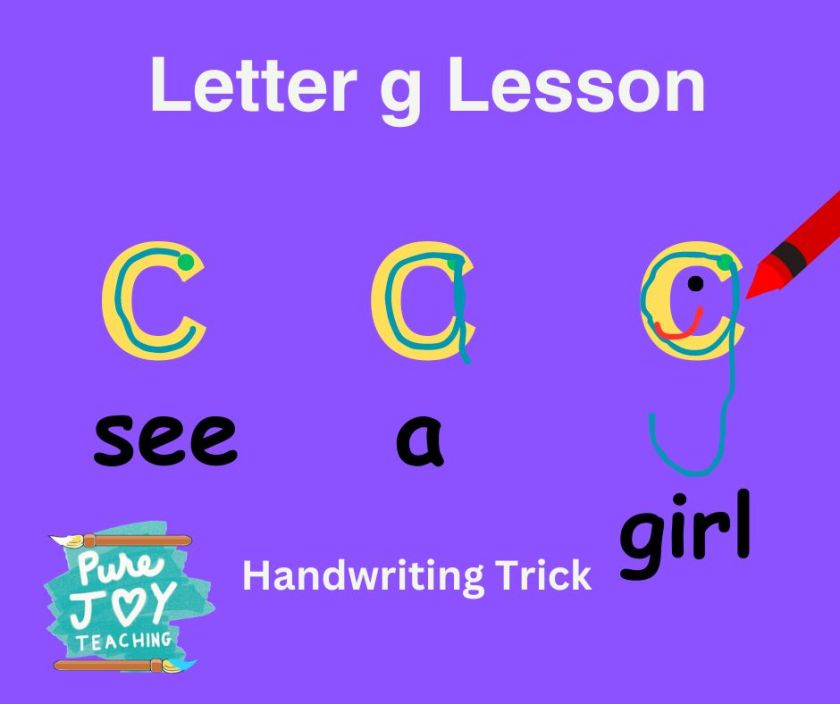
Clever handwriting trick for making the letter and the hard g sound.

Watch this super simple video a few times. Learn to make the lowercase letter g in three easy steps and remember the hard /g/ sound with the word “girl.”

See /c/, /a/, /g/ girl. YouTube Video Here.

Pure Joy Teaching. Handwriting Trick for the Letter /g/.

This video was made at the request of a mother who was trying to teach her daughter to make the lowercase /g/ correctly and remember the letter sound, too.

Understanding the Lowercase Letter ‘g’: Overcoming Common Struggles

For many students, the lowercase letter ‘g’ can be a tricky one to learn, both in terms of its sound and its shape. While these challenges are quite common, understanding the reasons behind them can help students overcome confusion. They can master the letter with ease with these helpful tips. Let’s break down two main difficulties students often face when learning the lowercase ‘g’.

1. Letter Sound Confusion: The Soft ‘g’ and the “j” Sound

One of the biggest challenges students encounter is distinguishing the sound of the letter ‘g.’ When we say the name of the letter “G,” it sounds like the “j” in words like “giraffe.” This can lead to confusion because the letter ‘g’ actually has two distinct sounds in English:

  • The hard ‘g’ sound, as in “go” or “girl.”
  • The soft ‘g’ sound, as in “giant” or “giraffe.”

Because the letter name sounds like a soft “j,” students can mistakenly believe that the letter always makes the soft sound. Helping students practice both the hard and soft sounds of ‘g’ can clear up this confusion.

2. The Shape of Lowercase ‘g’: Confusion with Capital G

Another challenge is the shape of the lowercase ‘g,’ which can easily be confused with the capital letter ‘G.’ The lowercase ‘g’ is unique because it has a loop at the bottom that faces the opposite direction of the capital ‘G.’ This can be difficult for students to grasp, especially since both letters look somewhat similar. If they have learned the capital letter first, they may influenced by that initial shape curving the other direction.

To help students remember the lowercase ‘g’ shape, it’s important to practice writing the letter step by step:

  • Start by drawing the letter /c/.
  • Then, make it into the letter /a/ by sliding up and down to the line.
  • Finally, complete the letter by drawing a little tail that hangs out to the left side. Very simular to the letter /j/ tail.

By focusing on these specific steps and practicing the direction of the curve, students can avoid mixing up the lowercase ‘g’ with its capital counterpart.

The Importance of the Starting Point

The lowercase letters c, a, and g, all have the same starting points. Unlike most lowercase letters the /c/ shaped letters move in the opposite direction of normal English reading. The /c/ shaped letters start at the top and move from right to left. This book is helpful for teaching these letters.

Tips for Teaching the Lowercase ‘g’

  1. Use Visual and Auditory Cues: To reinforce both the sound and shape of ‘g,’ this video can be a helpful tool.
  2. Practice Writing: Give students plenty of opportunities to write lowercase ‘g’ repeatedly, encouraging them to focus on the starting point of the letter /c/. and the direction of the curve. It can also be helpful to trace the letter first, then try writing it independently.
  3. Focus on the Sound: Practice distinguishing between the hard and soft ‘g’ sounds in various words. Reading aloud and singing songs with the letter ‘g’ can help students become more familiar with the sound.

Conclusion

While the lowercase ‘g’ may seem tricky at first, understanding the reasons behind the confusion can help students master both the sound and shape of the letter. By practicing consistently and breaking down the challenges step by step, students can overcome their struggles and gain confidence in their learning journey. With patience and the right approach, the lowercase ‘g’ will become second nature!

Pure Joy Teaching

Handwriting Video Letter Group C

C-Shaped Letter Group

The C-Shaped Letters are c, a, g, d, q, o, s, e

The Importance of Correct Letter Formation: How Understanding the “C” Shape Can Help With Writing Letters Like lowercase a, g, d, q, o, and s

Learning to write is one of the most foundational skills children acquire, and proper letter formation is a key component in developing legible handwriting and decoding text. One effective way to teach this is by focusing on the shared shapes and movements that many letters have in common. This is especially true when it comes to the “C-shaped” letters—c, a, g, d, q, o, and s. These letters all begin with the same basic motion, which makes mastering their formation easier and more intuitive.

Letter is e, is also included in this group because it shares the same “c” shape curve. The lowercase letter /e/ has a rare starting place in the center of the letter between the lines.

Why Focusing on the “C” Shape is Helpful

The concept of the “C-shape” refers to the curved stroke that forms the initial part of several letters. By recognizing that many letters share this common starting point, children can develop muscle memory that will help them write these letters more fluently and correctly. Here’s why it’s so beneficial:

  1. Consistency in Movement: All the “C-shaped” letters—c, a, g, d, q, o, and s—start with a curved stroke. This consistent motion reduces confusion for young learners who might otherwise feel overwhelmed by the differences between each letter. Once they master the curve, they can apply it to multiple letters.
  2. Building Confidence: When children see that many letters share a similar starting stroke, they gain confidence. Instead of learning each letter individually from scratch, they understand that a large portion of their task is already the same. This helps reinforce a sense of achievement early on.
  3. Muscle Memory: Proper formation of each letter is essential for developing legible handwriting. Starting with a consistent motion that works for several letters helps the child develop the fine motor skills needed to form these letters efficiently. Repeated practice of the “C” shape strengthens hand-eye coordination and improves control over the writing utensil.
  4. Improved Readability: Correct letter formation leads to more legible writing. When children are taught to form letters like – a, g, d, q, o, and s with the same initial stroke, their writing becomes smoother and more consistent. The clear structure of each letter helps others easily read and understand their work.

The Key Letters That Share the “C” Shape

Here’s a breakdown of how these letters are formed and why their shared beginning is so useful:

  • c: The letter C begins with a simple, open curve that gently curls from top to bottom. It’s the perfect starting point for understanding how a curved stroke can be controlled.
  • a: Starting at the top with a curved stroke similar to the C, A then forms a pointed peak. This shared beginning helps learners transition from the open curve of C to the pointed structure of A.
  • g: The letter G shares a similar shape to C but adds a small horizontal line at the bottom. Understanding how the curve connects to the baseline in C helps learners add the horizontal stroke to form G.
  • d: Beginning like c, the letter d, incorporates a straight line down the right side to complete its form. The curved stroke serves as the foundation for creating the full d shape.
  • q: The letter q begins like the letter c, then drops down with a straight line to create a hanging letter.
  • o: O mirrors the C in terms of its curved stroke, but it forms a complete circle. Once children can form the C shape, drawing O becomes a natural next step. They should start the letters in the same spot to the right. Not in the center.
  • s: The letter S starts with a small C-like curve that loops back on itself. This shape may appear complex, but it becomes easier once learners understand how to curve the stroke in a continuous motion. Remind students that letter /s/ starts with a small /c/ shape then turns and flips into a backward /c/ shape.

How a Video Can Support Learning

Using a video to demonstrate how to form these “C-shaped” letters is an excellent way to reinforce proper letter formation. Visual learners can benefit from seeing the motion in real time, as it helps them better understand how to make the connections between each letter. A video can also provide:

  • Slow-motion tutorials to break down the steps for each letter.
  • Interactive feedback to encourage learners to try forming the letters themselves. Using whiteboards, paper, sand, or air writing.
  • Multiple examples to ensure mastery of the technique.
Pure Joy Teaching the C-shaped letters

Conclusion

Focusing on the common “C-shape” in letters like -c, a, g, d, q, o, s, and e, offers a practical and effective way to teach children proper letter formation. By highlighting the shared motion and stroke, children can build confidence, improve their handwriting skills, and progress through these letters more smoothly. Using video resources to reinforce these concepts can further enhance learning, providing visual cues and demonstrations that support the development of good handwriting habits.

For C-shaped resources see my book,

Learning to form letters can be easy and fun. Start with a few at a time, within the letter groups and mastery should come with practice.

See the whole collection: r-shaped letters, straight line letters, slant line letters.

Have Pure Joy Teaching

pure joy teaching

C Pirate Letters Sand Tray

Correct formation of the letter e is very important. This has been helpful for many students. Letter e is the only letter that starts in the middle.

Montessori-Style Letters with an Engaging Pirate Theme

Handwriting can be an engaging activity with a pirate theme in a sand tray. In book two of this handwriting letter adventure, the pirates have just realized that they have no vowels. All the letters that they learned in book one can not be used to spell any real words. Their excitement turns to confusion.

A cheeky bird calls out, “Aw, au vowels.” Then it flies away.

The pirates rapidly chase after the bird and learn to make the C-shaped letters along the way. This group includes c, a, g, d, q, o, s, e.

Sand Trays

The use of sand trays in the Montessori style is one of my favorite ways to practice letters. Normally, I just would rotate different colors of sand, or customize the tray bottom with different colored or shiny paper. But this storybook pirate theme opens up my options and lets me add items from the book. The kids can recreate the letters by following along or re-enacting the story. This gives me more opportunities to talk to them about starting spots and correct letter formation in a fun way.

Choosing the right supplies to make a mini fake coconut for the C-letter theme.

Gathing Supplies for the C-Letters to Trace Around

Any box will do to make your own sand tray. It can be a fancy wood one like this, or a shallow box with a lid if you are concerned with spills. The fake coconut may be harder to find. My husband brought me a macadamia nut still in the shell. I think is the perfect size. I need to cut it and paint the inside white. The larger object next to it was an avocado seed, but the shape it off. I don’t think I will use that one.

Yellow paint on the coin gave it extra shine.

Pirate gold at the top marks the start spot for most of the letters in the group. I had a foreign coin that was about the size of a penny, with some extra yellow paint added, it now stands out from the sand color. This was the best size for my small box. If your box is bigger, you could use the fake gold they sell in the party supply stores.

The Letter e, Starts in the Middle

You might want to have one fake coconut that is still whole and roll it in your sand tray for the letter e. In the story, the pirates hear a weird noise in the brushes and one of them rolls a coconut like a bowling ball in a straight line. Then, the monkey pushes it away and it makes the letter e shape.

When I teach this to students at my writing table, I open the book and show them the pictures. We say the steps together roll it straight and the monkey pushes it around in the c shape. That is the letter e. This has been helpful for many students. Letter e is the only letter that starts in the middle.

Correct formation of the letter e is very important. Many students make sloppy rushed letters. In the case of letter e, it might look the same as the letter c. This is a problem that impacts spelling especially if the /e/ is close to the letter /k/. Then the word looks like it ends with /ck/.

You can order the books from Amazon and the letterstrips, letter cards and worksheets can all be found on TPT.

The adventure continues, the pirates think that someone has been digging for treasure on the island. A huge surprise in the sand leads them to learn the next set of straight-line letters.

These letters are the third handwriting group they learn: i, j, l, t, f, k.

The straight lines of the turtle tracks leading to the water are a very good way to explain the direction of travel and remember to start at the top. The hatchling eggs mark the dot on top of the letters i and j.

Pirate theme handwriting letters

Book 3 of the handwriting adventure.

The pirate’s journey is complete and they find the last vowel and the treasure in book four X Pirate Letters. Shark teeth are used to make the pointy slanted line letters.

The whole pirate adventure is available in one storybook on Amazon. The Pirate Letters: Lowercase Handwriting Storybook.

Have Pure Joy Teaching

The b fits in the Left Hand

This is a helpful way to remember which way the letter b is going

b/d Reversals Tricks and Tips

b d reversals. Do your students ask this question a lot? Which way is b?

This poster is a helpful way to remember which way the letter b is going. It should fit in your left hand. Find it here on TPT.

This works for students who are right-handed writers.

Pure Joy Teaching

You might also like this hb hb go the same way. Great for letter b reversals.

Back to School Handwriting Program

letter shape patterns help to avoid letter confusion.

Engaging Handwriting Orton-Gillingham Styled Letter Tracables and Story Book Lessons

This book and handwriting program has fun visual links to help students see the letter shape patterns and avoid letter confusion.

Great for back-to-school, colorful pictures with an animal and pirate theme.

Find the book here on Amazon. The printables can be purchased on TPT

Hu bu hu bu Handwriting – Helps with b d reversals

Letter reversals can be a huge problem, and sometimes the letter b comes out looking like the number 6. 

This is a fun way to practice the correct letter formation and the letter sounds at the same time.

Letter reversals can be a huge problem, and sometimes the letter b comes out looking like the number 6.  Some students start both by drawing a straight down and then they can not remember which way the b or d should turn.

So we use the h b h b practice.  I tell them the letter h and b are almost the same, the only difference is the letter b is closed at the bottom. So, make the tall letter h then close the bottom. Now it is the letter b.  Be sure to make the letter sounds when you write.  “h, b, h, b.” This is very important to make the letter sounds. Be careful not to use the letter name too much. Referring to the letter by its sound can help to avoid letter name interference. Letter name interference is very common with w, y, and u.

How to correct b and d reversals in handwriting

©Pure Joy Teaching

This is also a great time to remind them that the letter h is a tall letter, and the letter n is a small letter.

It is super important that students learn to start the letters at the top, not the bottom. We have found that when students start the letters on the bottom line there is a good chance that they will turn out backwards. We were seeing confusing letters and thought “Is it dyslexia?” In this case no, it was not. It was just bad handwriting habits that needed to be corrected by teaching the students to start the lowercase letters at the top, and not the bottom.

This is one of the reasons that I wrote this book R’s Pirate Handwriting Storybook. The shape of the letter r is a really good way to group all the letters that make the same starting shape. Practicing these letters together can also help remove the b d confusion. This book series is full of effective practices for teaching writing.

Have Pure JOY Teaching

https://www.teacherspayteachers.com/Sellers-Im-Following/Add/Pure-Joy-Teaching

You might also like these!

Waffle Letters butter drip shows the direction of handwriting

Capital and lowercase letters with start spot butter drip alphabet

Match up the letters in the waffle maker, or trace them out with marker or playdough. The important thing is to always start your letters at the top. The butter dip shows the direction in which your pencil should start to draw these letters. It is a great way to sort the letter too. Which ones curve, which letters slide, and which letters are straight?

This is a fun way to add play with practice in a dramatic way.

C-shaped letters, c, g, d, a, s, all have the same start. © Pure Joy Teaching

Look for this on TPT my Shop

This can be printed out for all kinds of fun play, matching, or tracing.

Pure Joy Teaching 2023

You may also like these!

Pirate Handwriting Storybook – Four Adventures in One Complete Book

Foundational skills of handwriting and vowel knowledge are a huge treasure for kids. Treasure-seeking pirates find things in the sand to trace around. This is how they learn the new skill of handwriting. Pirate-themed word-play helps create a memorable and fun storyline, with playful use of the letters: r, i, c, and x. The similar grouping of letter shapes makes it easy for them to learn the four-letter groups quickly. Special attention is shown to the importance of the vowel letters.

Four Pirate Adventures. Four Visual Handwriting Discoveries.

Join the pirates as they explore their island and uncover the patterns hidden within lowercase letters!

Buy It on Amazon!

From r-shaped seaweed to coconut c-shaped curves, then on to straight-line turtle tracks and slanted shark-teeth letters, each adventure introduces a different group of lowercase letters through imaginative visual clues and storybook illustrations.

Follow the pirates with messy map pro from their first discovery of letter formation to their final discovery of all five vowels. Four adventures, one continuing story, and a treasure trove of handwriting discoveries!

Four Pirate Adventures in One Complete Storybook

Why Four Letter Groups in One Story

Each story builds one skill of handwriting, then the next story groups letters of similar shape and starting points, till they complete all the styles.

Four books in one. The complete lowercase letter handwriting storybook collection in a one-book volume.

Treasure-seeking pirates find things in the sand to trace around. This is how they learn the new skill of handwriting. Pirate-themed word-play helps create a memorable and fun storyline, with playful use of the letters: r, i, c, and x. The similar grouping of letter shapes makes it easy for them to learn the four-letter groups quickly. Special attention is given to the importance of the vowel letters. With the help of a chatty parrot, the story has incorporated a few vowel sounds. Each letter has a specific visual cue to demonstrate the correct letter starting point. The letters are organized in clusters to help correct letter reversal errors. Each book in the series shares a close relation to Orton-Gillingham’s Style of handwriting instruction groups.
Handwriting is an adventure to treasure.

The four titles included in this book: R’s Pirate Letters, C Pirate Letters, I Pirate Letters, X Pirate Letters.

This complete storybook brings together all four Pirate Handwriting adventures, from R Pirate Letters through C and I Pirate Letters to the final adventure, X Pirate Letters.

Likewise, the posters and cards for these writing lessons are a great match for this book.

Visual handwriting support images

Visual Links to Handwriting Groups

1. r, n, m, h, b, p –  Letter r is seaweed on the sand; the pirates trace the /r/ shape, and that helps to make the other letters in this group. These are the dive down, slide up, and hook letters. Dark blue water is on the bottom of the cards.

2. c, a, g, d, q, o, s, e – Letter c is half a coconut. The pirates trace around it in the sand to make the curved letters in this group. These are the /c/ curved letters that share the same starting point. Letter e was added to this group. (funny story in the book for letter /e/) Tallgrass on the bottom of the cards. Great for sand trays.

3. i, j, l, t, f, k –Letter i: tracks made by turtle hatchlings. The pirates copy the straight-line letters in the sand. Light blue water is on the bottom of the cards.

4. v, w, y, x, z, u – Letter x: These are the v-shaped letters; it traces around a shark’s tooth. These are the slanted line letters. Letter u was added to this group. (funny story in the book for letter /u/) Tree trunks are on the top of these cards. The letter x is the title of the book because, of course, the pirates use the all-important x to mark the spot for the treasure.

Pure Joy Teaching
© Pure Joy Teaching